
Tower Shield: Advanced Cooling Water Treatment System for Cooling Towers
Cooling towers are an essential part of many industrial and commercial operations. From power plants and manufacturing facilities to hotels, hospitals, and large HVAC systems, cooling towers help remove excess heat and maintain efficient operating temperatures.
Cooling towers continuously circulate water to remove heat. As water continuously evaporates, dissolved minerals, contaminants, and microorganisms become increasingly concentrated in the system. Without effective cooling-water treatment, this can result in:
- Mineral scale deposits
- Corrosion of metal components
- Microbiological growth and biofouling
- Reduced heat-transfer efficiency
- Increased blowdown
- Higher freshwater consumption
- Increased maintenance
- Higher chemical-treatment costs
These problems can affect heat-transfer efficiency, equipment life, water consumption, maintenance requirements, and overall operating costs.
The Challenge
Scale, corrosion, and biofouling create significant limitations.
The more water is allowed to evaporate and remain in circulation, the more concentrated the dissolved substances become. Eventually, some of this concentrated water needs to be removed from the system through blowdown. Fresh water is then added as makeup water. This cycle is necessary to keep dissolved solids and other contaminants within acceptable operating limits.
But frequent blowdown also means:
More water discharged → More makeup water required → Higher water consumption
For facilities operating large cooling towers, this can represent a significant amount of water and operating cost.
The Traditional Approach to Cooling Water Treatment
Conventional cooling-water treatment typically uses different chemicals to manage various challenges in the system.
Depending on the application, treatment programs may include chemicals for:
- Scale control
- Corrosion inhibition
- Microbiological control
These programs can be effective, but they also involve ongoing chemical procurement, storage, dosing, handling, monitoring, and replenishment.
For facilities looking to reduce their dependence on conventional chemical treatment while improving water efficiency, an alternative approach is becoming increasingly relevant: Electrolytic cooling-water treatment.
Introducing Pristine Water’s Tower Shield?
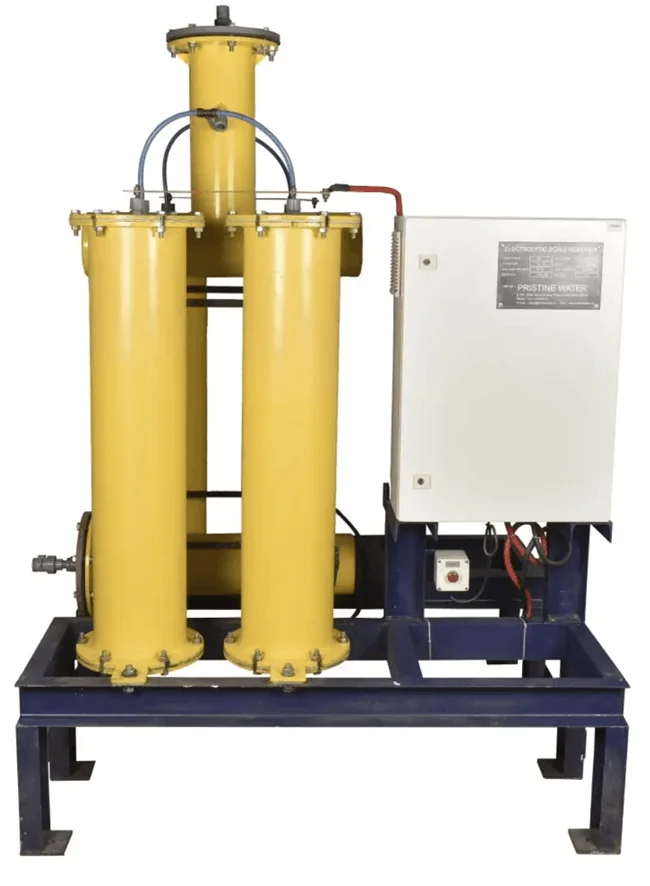
Pristine Water’s Tower Shield is a Cooling Water Treatment System designed to address the three fundamental challenges of cooling-water systems:
- Scale Removal
- Corrosion Inhibition
- Biofouling Control
Unlike a system focused only on scale removal, Tower Shield takes a more comprehensive approach to cooling-water management. Its objective is to control the factors that limit the operating concentration of cooling water, allowing the system to operate at higher COC (Cycles of Concentration).
This can help facilities use the same cooling water for longer, reducing blowdown, makeup-water requirements, and dependence on chemical treatment.
How Pristine Water’s Tower Shield Addresses the Three Cooling-Water Challenges
-
Scale Removal
Tower Shield uses an electrolytic treatment process to help manage scale-forming minerals in the cooling-water system. The process promotes controlled precipitation of calcium carbonate, allowing scale-forming material to be captured and removed rather than accumulating on critical heat-transfer surfaces.
This helps maintain cleaner surfaces and supports efficient heat transfer.
-
Corrosion Inhibition
Tower Shield also incorporates corrosion inhibition as part of its cooling-water treatment approach. By controlling the conditions within the cooling-water system, the technology helps protect metal surfaces from corrosion.
This supports the long-term reliability and integrity of cooling-water infrastructure.
-
Biofouling Control
Microbiological growth is another important factor when operating cooling water at higher concentrations. Tower Shield’s electrolytic process can generate chlorine from chloride naturally present in the cooling water, contributing to microbiological control.
This helps address biological fouling as part of the overall cooling-water treatment process.
The real advantage of treating scale, corrosion, and biofouling together is their impact on COC (Cycles of Concentration).
When these three challenges are effectively controlled, cooling water can potentially be concentrated further before blowdown becomes necessary. Tower Shield can help cooling-water systems move from a COC of around 2 to more than 6, depending on the system’s water chemistry and operating conditions.
A More Sustainable Approach to Cooling Water Treatment
Water conservation is becoming an increasingly important consideration for industrial and commercial facilities. Cooling towers can consume significant quantities of water through both evaporation and blowdown.
Improving COC provides an opportunity to reduce this consumption without compromising the fundamental purpose of the cooling system.
By combining: Scale Removal + Corrosion Inhibition + Biofouling Control
Tower Shield helps facilities work toward:
Higher COC + Lower Blowdown + Lower Makeup Water Consumption
This makes cooling-water treatment not just an equipment-protection strategy, but also an important part of water conservation and operational efficiency.
Where Can Tower Shield Be Used?
Tower Shield can be considered for cooling-water systems across industries where cooling performance, water consumption, and equipment protection are important.
-
Power Plants
Cooling systems are critical to power generation, making effective water and equipment management essential.
-
Manufacturing & Process Industries
Industrial facilities often use cooling towers for process and equipment cooling and can benefit from improved cooling-water management.
-
Commercial HVAC
Hotels, hospitals, commercial buildings, and large facilities can use cooling towers as part of their HVAC systems.
-
Food & Beverage
Process cooling and HVAC systems can require significant quantities of cooling water, making water efficiency an important consideration.
Beyond Scale: A More Sustainable Cooling Tower Strategy
Water is becoming an increasingly important operational consideration for industries around the world. Cooling towers can consume substantial quantities of water because evaporation and blowdown continuously remove water from the system. This makes cooling tower water conservation an important consideration for modern industrial facilities.
Reducing unnecessary blowdown can help facilities:
- Lower freshwater consumption
- Reduce wastewater discharge
- Improve water-use efficiency
- Reduce the volume of water requiring treatment
- Improve overall cooling-system sustainability
Pristine Water’s electrolytic cooling-water treatment technology is designed with this objective in mind, with the company reporting significant blowdown and overall water savings.
Why Pristine Water?
Pristine Water specializes in water and wastewater treatment technologies designed for industrial and commercial applications.
Its electrolytic cooling-water treatment solution combines scale removal, calcium capture, and chlorine generation in a low-maintenance system designed to reduce the need for chemical addition and handling.
The system can be integrated with existing cooling-water pipework, making it a practical option for facilities looking to improve their existing cooling tower treatment strategy.
Talk to Pristine Water
Looking to increase the efficiency of your cooling-water system, reduce blowdown, conserve water, and reduce chemical-treatment costs?
Talk to Pristine Water about Tower Shield and discover a smarter approach to cooling-water treatment.