
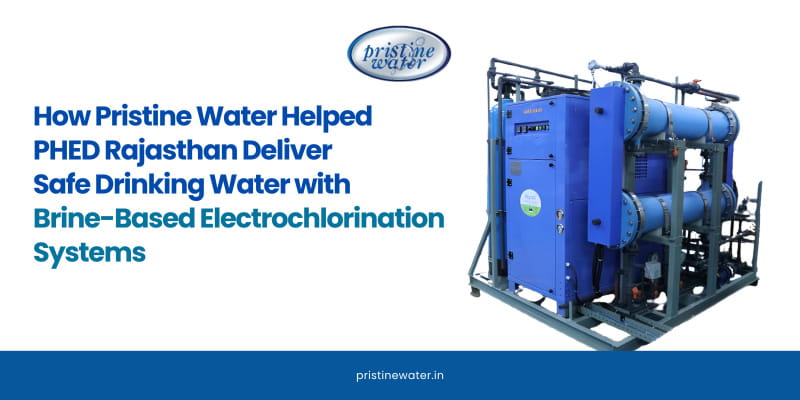
How Pristine Water Helped PHED Rajasthan Deliver Safe Drinking Water with Electrochlorination
Access to clean and safe drinking water is one of the most critical public health priorities in India. As urban populations grow and water demand increases, public utilities need reliable, cost-effective, and sustainable water disinfection solutions that can operate continuously without depending on hazardous chemical transportation.
Pristine Water partnered with PHED Rajasthan to deploy advanced Brine-Based Continuous Process Electrochlorination Systems that ensure safe drinking water for communities across Rajasthan.
In this blog, we explore the challenges faced by PHED Rajasthan, the solution implemented by Pristine Water, and the outcomes achieved.
The Challenge: Ensuring Safe Drinking Water Across Rajasthan
Rajasthan depends significantly on river water and rainwater harvesting reservoirs to meet its drinking water requirements. While these sources are essential for sustaining millions of people, they are also highly vulnerable to contamination.
During the monsoon season in particular, water quality can deteriorate rapidly due to:
- Increased suspended solids
- Organic contaminants
- Bacterial growth
- Disease-causing microorganisms
- Seasonal fluctuations in water quality
For a public utility department like PHED Rajasthan, maintaining consistent water quality is essential to protect public health and comply with drinking water standards.
The organisation required a solution that could:
- Deliver continuous and reliable water disinfection
- Eliminate harmful microorganisms before water distribution
- Reduce dependence on transporting and storing commercial chlorine or sodium hypochloride
- Lower long-term operational costs
- Improve overall system safety
Pristine Water’s Solution
To address these requirements, Pristine Water supplied and commissioned Brine-Based Continuous Process Electrochlorination Systems with capacities of:
- 500 gm/hour
- 1 kg/hour
- 2 kg/hour
These systems generate sodium hypochlorite on-site using common salt (brine) and electricity, providing a continuous supply of disinfectant whenever required.
Unlike conventional chlorination methods that rely on transporting hazardous chemicals, electrochlorination systems produce fresh disinfectant at the treatment plant itself, making operations safer and more sustainable.
Key Features of the Solution
1. Continuous Process Operation
The systems provide uninterrupted chlorine generation, ensuring consistent water disinfection even during periods of high demand.
2. Automated Chlorine Generation and Dosing
Automation minimises manual intervention while maintaining accurate chlorine dosing for effective disinfection.
3. Reduced Chemical Dependency
Generating disinfectant on-site significantly reduces reliance on external chemical suppliers and the risks associated with transporting chlorine.
4. Lower Operating Costs
The systems use readily available salt and electricity, helping reduce recurring operating and maintenance expenses over the system’s lifecycle.
5. Safe and Environmentally Responsible
On-site electrochlorination eliminates many of the safety concerns associated with storing and handling hazardous chlorine chemicals while reducing environmental risks. This system uses just salt and water which are readily available and hence doesn’t need chemical transportation and storage thereby making it a lower carbon footprint option as compared to dosing commercially purchased sodium hypochlorite that degrades and loses its potency over time.
Results & Impact
The successful deployment of Pristine Water’s electrochlorination systems has strengthened Rajasthan’s drinking water treatment infrastructure by delivering a dependable and efficient chlorination solution.
Project Outcomes
- Reliable and continuous drinking water disinfection
- Improved protection against harmful microorganisms
- Reduced dependence on externally supplied chlorine
- Lower operational and maintenance costs
- Enhanced safety through on-site disinfectant generation
- Sustainable and environmentally responsible water treatment
By adopting electrochlorination technology, PHED Rajasthan has taken another important step towards ensuring a safe and consistent drinking water supply for communities across the region.
Why Electrochlorination is the Future of Drinking Water Disinfection
As municipalities and public utility departments seek smarter and safer water treatment technologies, electrochlorination systems are becoming the preferred choice.
The technology offers several advantages:
- Eliminates the transportation and storage of hazardous chlorine chemicals
- Produces fresh sodium hypochlorite on demand
- Reduces operating costs over time
- Improves operator safety
- Supports sustainable water treatment practices
- Ensures reliable disinfection for public water supply systems
For government agencies and water utilities, electrochlorination provides a future-ready solution that balances performance, safety, and operational efficiency.
Partner with Pristine Water for Reliable Water Disinfection Solutions
With over two decades of expertise in electrochlorination technology, Pristine Water has successfully delivered water disinfection systems for municipalities, industries, hospitals, and infrastructure projects across India and the world.
Whether your project involves drinking water treatment, wastewater reuse, or industrial process water, our solutions are designed to provide safe, reliable, and cost-effective disinfection tailored to your requirements.
Looking for a dependable electrochlorination solution for your water treatment project? Contact Pristine Water today to discuss your requirements and discover how our innovative systems can help deliver safe, sustainable water for every community.